



All-on-4 Dental Implants in Antalya, Turkey
For many people, the thought of losing teeth can be a very distressing experience. All-on-4 dental implants in Antalya, Turkey, offer a revolutionary solution that ends this difficult process with a permanent and natural-looking smile for patients who have lost all or most of their teeth. This implant treatment helps patients regain their chewing function, speech, and self-confidence.
What is the All-on-4 dental implant?
All-on-4 dental implants are a modern treatment method that provides complete dental restoration for patients who are completely edentulous or about to lose their remaining teeth, using only four titanium implants for each dental arch.
How does the All-on-4 implant?
All-on-4 implant is a rehabilitation approach aimed at maximising the use of the existing jawbone. The basic working principle and features of the system are as follows:
- Strategic Placement: Two of the implants are placed vertically in the front region of the jaw, while the other two are positioned at an angle of up to 45 degrees in the back region.
- Advantage of Angled Implants: The angled placement of the posterior implants increases the bone-implant contact surface, providing optimised support even with minimal bone volume. This technique eliminates the need for bone grafting (bone powder) procedures, which are often cumbersome.
- Protection of Anatomical Structures: The angled placement of implants reduce the risk of damaging critical structures such as the sinus cavities in the upper jaw or the main nerve canals (mandibular nerve) in the lower jaw.
- Quick Result (Immediate Function): All-on-4 implant allows for the placement of a temporary fixed bridge on the same day the implants are inserted. In this way, the patient can have functional teeth on the same day as the operation and leave the clinic with a full smile.
What materials are used in All-on-4 dental implants?
The idea is based on three main components: titanium roots which are embedded in the jawbone, abutments which connect the implant with the prosthesis and a fixed prosthetic bridge that replaces the teeth, usually supporting up to 12 teeth. Unlike traditional removable dentures, the All-on-4 does not cover the palate, does not slip in the mouth and has the closest chewing sensation and aesthetics to natural teeth.
Principal Components
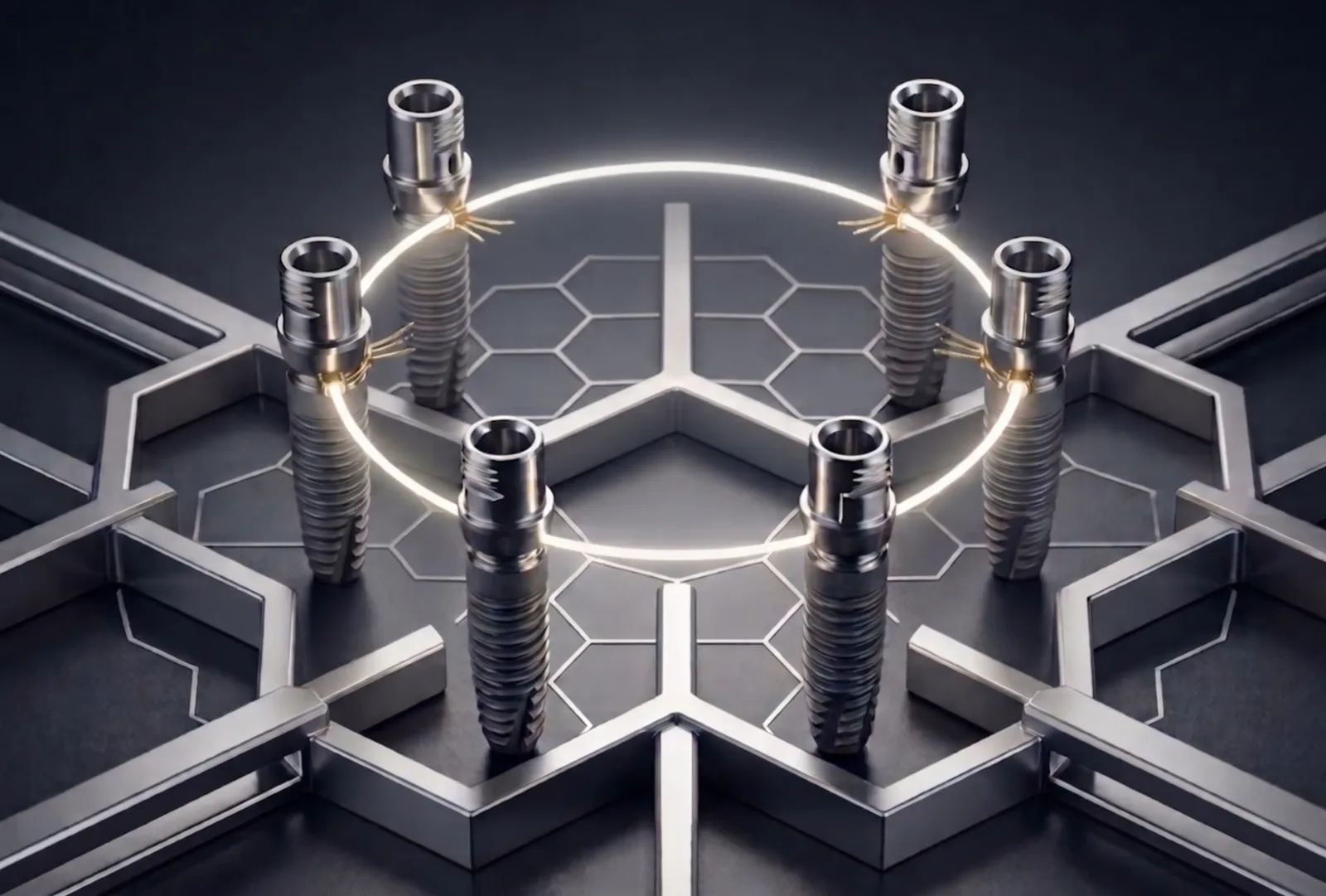
All-on-4 implant is essentially made up of three main parts and the auxiliary parts that connect them:
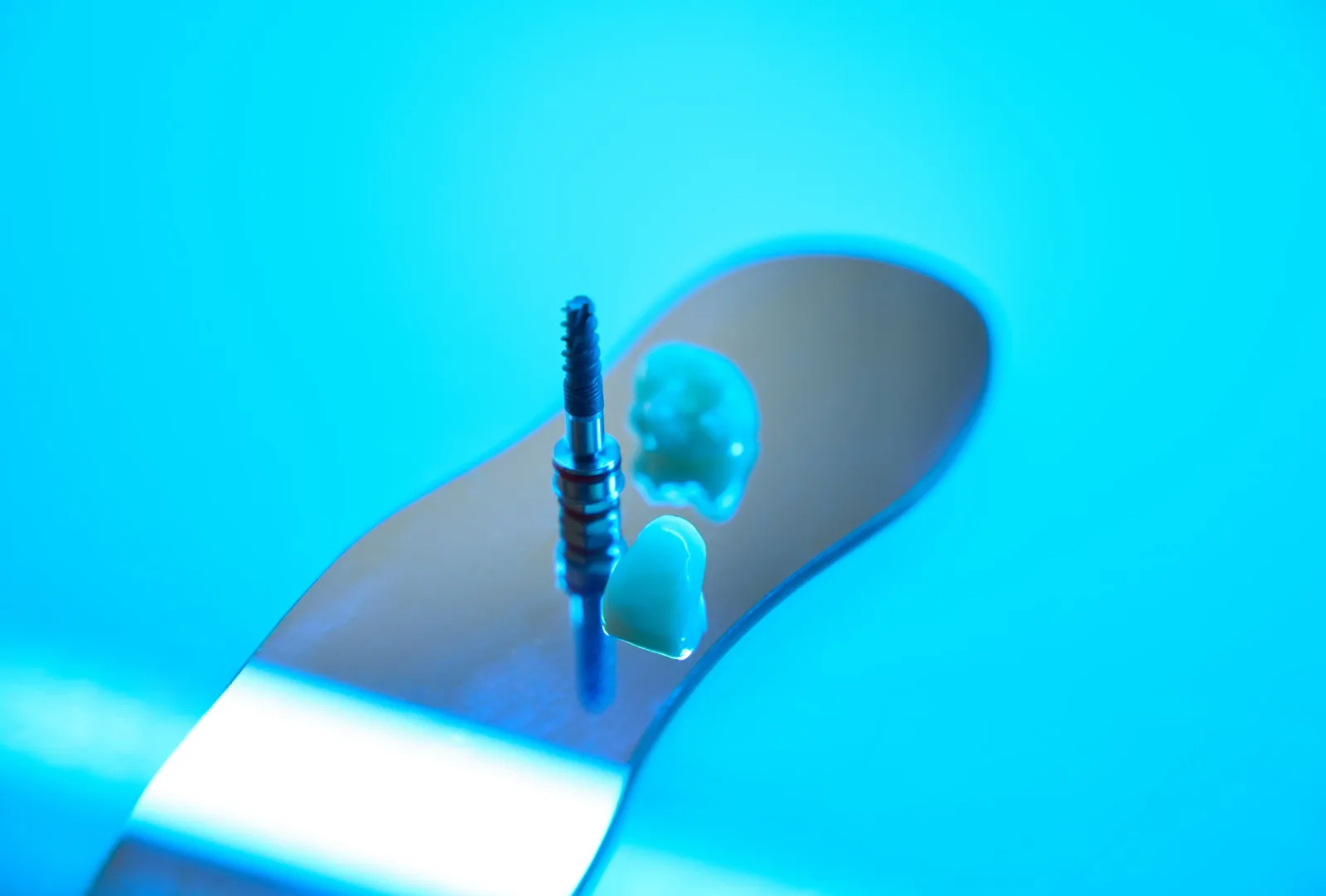
- Titanium Implants (Artificial Roots): Four titanium screws are surgically placed in the jawbone to act like natural tooth roots. Titanium is a ‘bioactive’ material and bonds directly to the jaw bone for an unshakeable foundation.
- Abutments: These are connecting pieces fixed to the implants which connect the implants to the prosthetic teeth. This system is used in particular in multi-unit abutments. Depending on the angle of the implants and the thickness of the gum tissue, there are straight, 17° or 30° angled options.
- Fixed Bridge (Prosthesis): This is the visible part of the system and restores the function and aesthetics of natural teeth. Two types of bridge are used: a temporary acrylic bridge, placed at the time of surgery, and a permanent (final) bridge, made from materials such as zirconia, porcelain or composite, placed after healing.
Support Components
- Fixation Screws: These are special abutment and prosthesis screws for fixing the bridge to the abutments and the abutments to the implants.
- Temporary Copings: These are titanium or plastic parts ensuring proper fitting and a firm attachment of the prosthesis to the abutments.
- Laboratory Parts: Impression copings, implant analogues (models) and guide parts used by the dental technician in the construction of a prosthesis.
What is the difference between All-on-4 and All-on-6 implants?
The major difference between All-on-4 and All-on-6 treatment implants is the number of implants, degree of support, and suitability of the patient’s jawbone structure. The distinctions between the two procedures are:
- Number of Implants: The most obvious difference is the number of titanium posts used to support each dental arch: All-on-4 uses 4, while All-on-6 uses 6.
- Support and Stability: The All-on-6 system has more implants; therefore, it provides more support, stability and anchor points for the prosthetic dental arch. The two additional implants spread the forces of chewing more evenly over a larger area of the jawbone.
- Bone Needs: Usually, All-on-6 treatment needs more volume and density of bone. In contrast, All-on-4 can provide a solution even in patients with minimal bone volume by avoiding the need for bone grafting (bone powder) through angulated positioning of the implants in the posterior region.
- Surgical Procedure and Healing: All-on-4 is less invasive (requires less surgical intervention) than All-on-6, as it utilises fewer implants. This can speed the operation and increase the patient's comfort.
- Cost: All-on-4 is typically a more affordable option, since it requires fewer implants and components than All-on-6.
All-on-4 or All-on-6: Which one is better?
One cannot claim that one of the All-on-4 or All-on-6 implants is definitely ‘better’ than the other because the selection of which procedure to implement is dependent entirely on the patient's jawbone structure, bone density and clinical demands. Both technologies are compatible with the protocol ‘Teeth in a Day', and patients can walk into the clinic without teeth and walk out with set dentures on the same day.
All-on-4: When is it a better solution?
- Insufficient Bone Volume: All-on-4 is an appropriate treatment option in cases of extensive bone loss in the jaw, especially in the posterior regions. The posterior implants are angled at 45 degrees to maximise the use of the existing bone.
- No Need for Bone Grafting: With the angled placement, you typically don’t need bone grafting (adding bone powder) or sinus lift procedures. Such procedures are often expensive and labour intensive.
- Less Invasive Surgery: The surgical area is more confined with fewer implants (4), and the therapy is faster and less invasive.
- Cost-Effective: All-on-4 is a cost-effective and efficient alternative to the traditional approach, which requires 8 to 10 implants.
When is All-on-6 a better option?
- Adequate Bone Density: If the patient has enough jawbone volume and density to support six implants, All-on-6 may be the better choice.
- More Stability and Support: The All-on-6 system provides more anchor points for the prosthetic dental arch. This helps to spread chewing forces more equally over a larger area of the jawbone.
- Increased Feeling of Security: The increased number of implants helps to improve the stability of the prosthesis, providing additional support in particular in case of patients with powerful chewing muscles.
The decider: CBCT (3D) scan
The best way to know which system is the right one for you is to have a thorough check-up by your dentist. Your dentist will take a CBCT (computed tomography) scan to evaluate the amount and quality of your jawbone and then digitally arrange the best locations for the implants. All-on-6 is more stable and stronger than All-on-4, whereas All-on-4 is a quicker and cheaper option for the patient who has lost bone, as it does not require bone grafting.
Who are the suitable candidates for All-on-4?
The most suitable candidates for the All-on-4 treatment are generally individuals experiencing complete toothlessness or those who are about to lose most of their existing teeth. Whether a person is a definite candidate for All-on-4 is determined by a CBCT (computed tomography) scan and a clinical examination conducted by the dentist.
Dental Condition and Losses
- Completely Edentulous Patients: Individuals who have lost all their teeth in the upper or lower jaw are primary candidates for this method.
- Those About to Lose Their Teeth: It is an ideal "same-day teeth" solution for patients whose existing teeth are loose, unhealthy, and need to be extracted (who will soon be edentulous).
- Those Using Removable Dentures: People who complain about the movement, discomfort, or chewing difficulties of traditional dentures (false teeth) may prefer this treatment as a fixed solution.
Physiological and Anatomical Requirements
- Sufficient Bone Volume: For the implants to securely hold, the jawbone must have a certain width and height. Technically, there should be at least 10 mm of bone height in the upper jaw and at least 8 mm in the lower jaw, with 5 mm of bone width in both jaws.
- Patients with Bone Loss: Many patients who are considered to have insufficient bone for traditional methods can become candidates for this treatment without the need for a bone graft (adding bone powder) thanks to the angled placement technique of All-on-4.
General Health and Habits
- General Health Condition: Adults with good general health who do not have any conditions that would prevent surgery can apply for this treatment.
- Absence of Parafunctional Habits: Patients without severe parafunctional habits, such as teeth grinding (bruxism), which would excessively load the implants, are more suitable candidates.
- Smoking: Smoking increases the risk of implant failure, so patients who do not smoke or are willing to quit during the treatment process are better candidates.
Who is not a candidate for All-on-4 treatment?
All-on-4 implant treatment in Turkey has a very high success rate, but it may not be the right solution for every patient. Below are the situations where this treatment is contraindicated or risky:
- Inadequate Bone Volume and Density: The bone must have a certain width and height to place the implants. In the upper jaw there must be at least 10 mm bone height, and in the lower jaw at least 8 mm bone height; the bone width in both jaws must be at least 5 mm. For patients who do not meet these criteria, the standard All-on-4 protocol cannot be applied, but additional surgical options such as zygomatic implants can be considered.
- Uncontrolled Systemic Diseases: The presence of uncontrolled diabetes or other chronic diseases that directly influence bone health are significant risk factors for implant failure.
- Smoking: Smoking is one of the main factors that can contribute to implant loss, as it adversely affects the process of osseointegration, where the implants fuse with the jawbone.
- Severe Teeth Grinding (Bruxism): Patients with uncontrolled or untreated severe teeth grinding habits (parafunctional habits) are not considered appropriate candidates. This habit can put too much pressure on the implant posts and cause the system to break or come loose.
- Untreated Gum Diseases: If there is an active infection or advanced gum disease (periodontitis) in the mouth, this condition must be treated before the implant operation.
- Inability to Achieve Primary Stability: For the “Teeth in a Day” protocol to be feasible, the implants must resist a minimum of 35 Ncm of compressive torque during surgery. If the quality of the bone of the patient is too soft to allow such a tightness, fixed temporary teeth cannot be placed immediately, and a traditional healing process is expected.
- Poor Oral Hygiene Habits: The longevity of implants is determined by the patient’s daily cleaning discipline and regular professional care. In people who do not pay attention to oral hygiene, the risk of developing peri-implantitis (infection around the implant) is very high, which can lead to the complete loss of the implant.
How is All-on-4 treatment performed in Antalya, Turkey?
All-on-4 implant treatment in Antalya, Turkey comprises a series of clinical and laboratory procedures that must be performed rigorously from the first patient visit to the clinic until the final dentures are delivered. This technology is scientifically proven, has a high success rate and lets patients have functional, aesthetically acceptable dentures in one day. The process includes the following steps:
Valuation and Digital Design
The dentist will begin with an intraoral examination and assessment of the bone structure.
- Imaging: We will take CBCT (computed tomography) and X-rays to assess the patient’s jawbone volume and density.
- Digital Simulation: The digital software, from the 3D pictures obtained, allows you to plan the best placements, angles and depths for the implants.
- Model Fabrication: Models of the patient’s current dentition or of the proposed new teeth are made before surgery.
Surgical Stage (Implantation)
Generally, the procedure is performed under local anaesthesia or sedation to ensure patient comfort.
- Preparation: Any loose teeth are removed if necessary, and the bone crest level is prepared for the implant insertion.
- Placement: Four titanium implants are placed in appropriate positions. In the front zone, 2 implants are placed vertically, and the other 2 in the posterior zone are placed at an angle of up to 45 degrees.
‘Same-day teeth’ (Provisional Fixed Prosthesis)
The patient does not leave without teeth, which is a big advantage of the All-on-4 implants.
- Multi-Unit Abutment: Abutments (connectors) are placed on the implants supporting the prosthetic.
- Temporary Bridge: The day of the surgery, a prepared temporary acrylic bridge is screwed into the implants to hold it in place. During the period of healing, these teeth are used for chewing and aesthetics.
Osseointegration (Healing Process)
The implants need a period of 3 to 6 months to completely fuse with the jawbone.
- Diet: At this stage the patient is advised to eat soft foods so that too much strain is not put on the implants.
- Tissue Healing: After this time, the healing of the gums and the stabilisation of the bone structure are complete.
Permanent Final Restoration
When the healing is done, the patient gets their permanent teeth. These teeth can be used by the patient for the rest of their life.
- Impression and Preparation: The temporary bridge is removed, and new impressions are taken.
- Permanent Bridge: The permanent prosthesis, made of very durable materials such as porcelain, zirconia or composite and attached to a titanium framework, is screwed onto the implants.
- Final Check: Treatment complete after checking bite force and aesthetic appearance.
All-on-4 treatment in Antalya, Turkey – Recovery process and things to remember
The recovery and aftercare process is an important part of your All-on-4 dental implant treatment in Antalya, Turkey. Following your dentist’s instructions during the healing period can help support implant integration and the long-term health of your new teeth.
Osseointegration (Recuperation Process)
- Duration: The titanium implants normally completely bond with the jaw bone within 3-6 months.
- First Few Days: Some redness, swelling and minor discomfort in the surgical area are normal for the first few days post-procedure.
- Speech: The patient may have a temporary lisp after the prosthesis is fitted, but in a few days the tongue will adjust to the new structure.
Nutrition Guidance
- Soft Diet: You will eat only soft foods until the implants integrate completely with the bone (first 3-6 months).
- First Two Weeks: Avoid hard, brittle foods. Instead, select foods that are pureed and will not stress the implants.
- Restrictions: Avoid chewing ice or hard sweets and cracking nuts, such as hazelnuts or walnuts, with your teeth, as this places too much stress on the implant posts and can lead to failure of the system.
Oral Hygiene and Cleaning Methods
- 0-14 Days: The surgical sites are very sore. Do not brush, but rather gargle gently with warm salt water 3-4 times a day. Do not use a water flosser or interdental brush during this period.
- 2–12 Weeks: You may be able to use a soft toothbrush and a water flosser (oral irrigator) on low pressure once your gums start to heal.
- Long-Term Routine: Brush twice a day and use an oral irrigator and Super Floss (special dental floss to clean under bridges) once a day for the rest of your life after your final prosthesis is in place.
Lifestyle and Risk Management
- Smoking: Smoking may hinder osseointegration (the bonding of the implant to the bone) and significantly increase the risk of infection. We therefore recommend that patients stop smoking during treatment.
- Teeth Grinding (Bruxism): Teeth grinding can be a problem, and it is important to wear the sleep guard your dentist recommends to balance the vertical forces on the implants.
- Warning Signs: Peri-implantitis (inflammation around the implant) can be indicated by bad breath, a metallic taste, bleeding gums or uncomfortable swelling around your implants, and you should see your dentist without delay.
Professional Treatment
You can’t just clean your house by yourself. You should come for regular dental check-ups once or twice a year to check the stability of your implants and to remove tartar from hard-to-reach places.
All-on-4 dental implants in Antalya, Turkey Cost
Cost-Affecting Factors
- Materials Used: Prices vary depending on whether the permanent (final) prosthesis is acrylic or composite-coated titanium or the premium option of zirconia/ceramic.
- Additional Surgical Procedures: The All-on-4 treatment frequently removes the need for bone grafting (bone powder), but in cases of significant bone loss, additional procedures or zygomatic implants may be necessary, which adds to the cost.
- Expertise and Technology: The cost reflects the experience of the dentist who performs the procedure and the use of advanced technologies such as CBCT (3D tomography) scans and computer-guided surgery.
Long-Term Cost Advantage
- Durability: Designed to last a lifetime, it eliminates the need for replacement every few years or frequent adjustments, as is the case with removable dentures.
- Cost-Effectiveness: Using just 4 implants instead of 8–10 individual implants reduces both the surgical procedure and component costs compared to traditional full-mouth implant treatments.
Average Price Ranges by Country (Per Arch/Jaw)
| Country | Estimated Price Range (Euro) |
|---|---|
| Turkey | €2,800 – €6,500 |
| United Kingdom | €12,000 – €25,000 |