



Dental Implants & Full Mouth Implants in Antalya, Turkey
Losing teeth affects far more than your smile. It changes how you chew and speak, and over time the jawbone beneath a missing tooth begins to shrink. Dental implants, and full mouth implant treatments, offer a way to restore that lost function and confidence for good. An implant is a titanium screw that takes the place of the natural tooth root and fuses with the jawbone, a process called osseointegration, giving the most durable and natural-looking result available, from a single tooth to a complete jaw.
Modern dentistry plans these treatments to millimetre precision using 3D CBCT imaging, digital workflows and CAD/CAM design, which makes results more predictable. Turkey, and Antalya in particular, has become a trusted destination for patients worldwide thanks to its experienced specialists, up-to-date technology and significant cost advantage.
What is a dental implant?
A dental implant is a small screw, usually titanium, that replaces a missing tooth root. It's placed surgically into the jawbone and gives a strong, stable base for a crown, bridge or denture. What makes implants so reliable is osseointegration: the jawbone fuses with the titanium surface and accepts it as part of the body.
What is a full mouth implant?
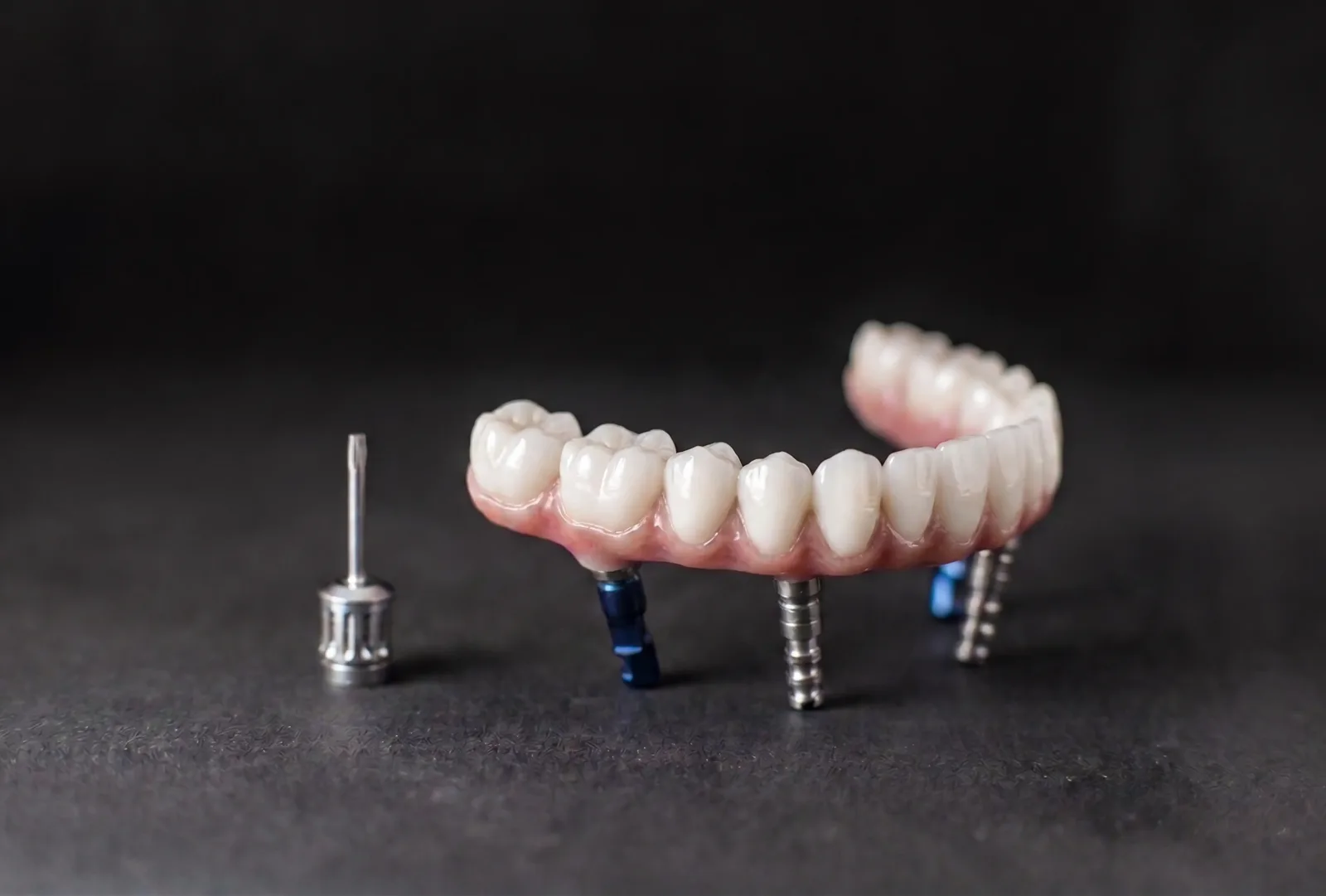
A full mouth implant is the answer when there are no teeth left in the upper or lower jaw, or when the remaining teeth need to be removed. A set number of implants is placed in the jaw, and a fixed bridge or prosthesis, usually zirconium or acrylic, covering the whole arch is secured onto them.
Full mouth implant treatment: is it meant for me?
Full mouth implant treatment is a complete restoration approach, usually for patients who have lost all or most of their teeth, or whose remaining teeth can no longer be saved. The main candidate groups and criteria are below.
Principal groups of candidates
- Total tooth loss (edentulism): Patients with no teeth in the upper, lower or both jaws. It's a permanent solution for those who struggle to chew with removable dentures or whose dentures constantly shift.
- Terminal dentition (teeth that can't be saved): Patients whose teeth are no longer functional because of severe gum disease, advanced decay or structural damage, and are scheduled for extraction.
- Patients who can't wear conventional dentures: Those with too little tissue for a denture to grip because of severe bone loss (atrophy), or whose mouth is constantly irritated by dentures.
General health and suitability standards
- Good general health: Because this is surgery, you need to be well enough for the procedure and the recovery that follows.
- Complete jaw development: Jaw and facial growth must be finished, generally from around age 18. Older age is not a barrier on its own; even patients over 80 can have implants if there's no surgical reason against it.
- Sufficient bone volume: Enough bone width and height is needed. Where bone is lacking, techniques such as sinus lifts, bone grafts or zygomatic (cheekbone) implants can solve the problem.
Specific medical conditions and points of interest
Some conditions aren't an outright barrier but should be under control before treatment:
- Diabetes: Well-controlled diabetes is fine, but high blood sugar can slow healing and raise infection risk.
- Osteoporosis and medication: Surgery is possible, but bisphosphonate medicines, especially the intravenous form, carry a higher risk of bone complications and must be flagged in advance.
- Heart disease: Severe cardiovascular disease needs medical clearance. For example, at least six months should have passed since a heart attack.
- Smoking: Smoking impairs healing and clearly raises the risk of implant failure. Most dentists ask patients to stop, or at least cut down.
Psychosocial and motivational factors
Full mouth rehabilitation is a long, step-by-step process, so it helps to have the patience and motivation to see a longer treatment plan through. Long-term success also depends on lifelong oral hygiene, including brushing and interdental cleaning.
Parts of dental implants
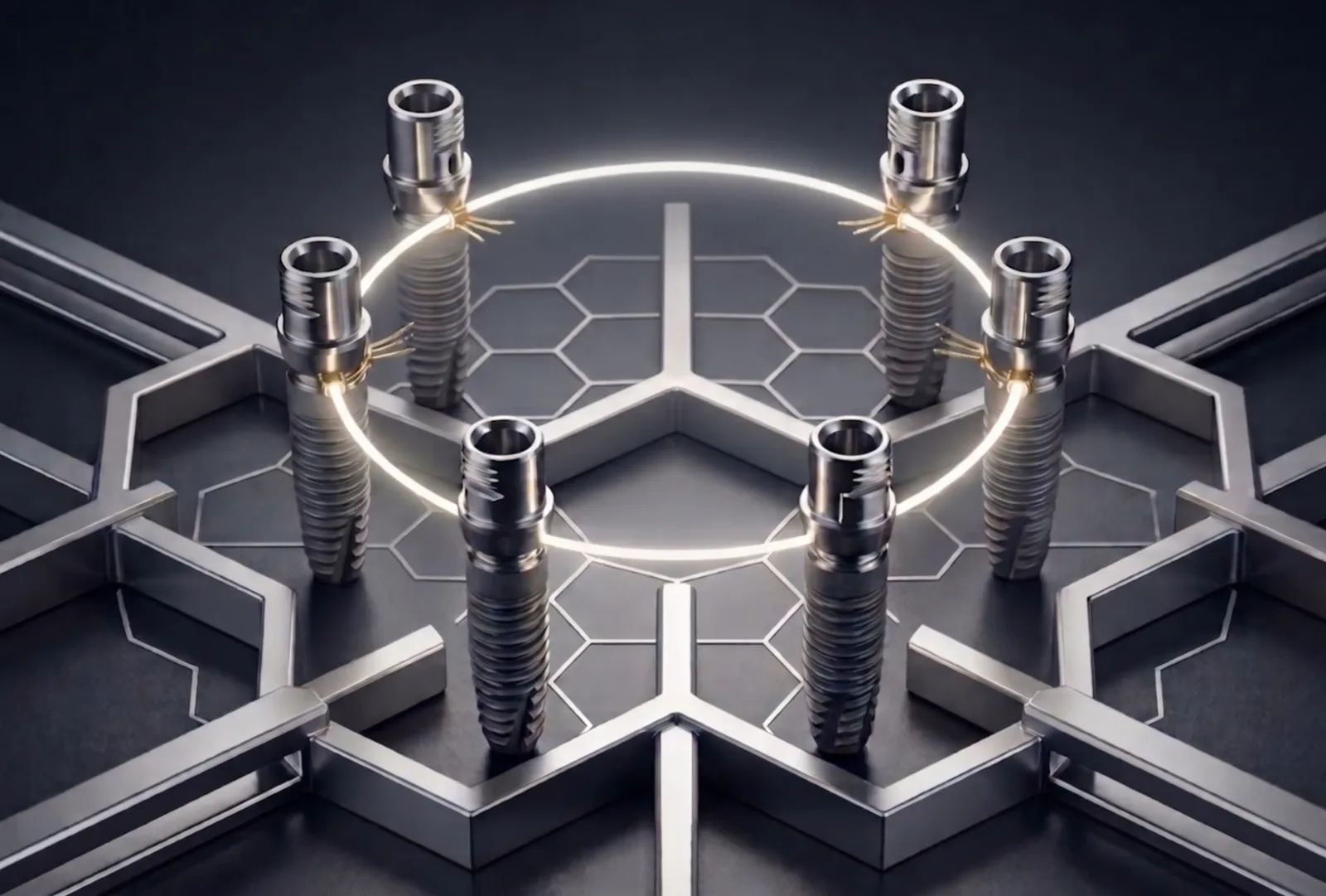
A dental implant has three main parts.
Implant screw (fixture)
This is the artificial tooth root, usually titanium or a titanium alloy, placed surgically into the jawbone. Its surface is roughened or chemically treated to speed up bonding with the bone.
Abutment (intermediate connecting piece)
This connects the implant screw to the part above it. It sits at gum level and holds the crown, and can be custom-made or off the shelf.
Crown (prosthetic tooth)
This is the visible part above the gum. It's custom-made from materials such as porcelain, zirconia or full ceramic, and closely resembles a natural tooth.
What are the full mouth implant techniques?
The two most popular and effective protocols are the All-on-4 and All-on-6 techniques.
All-on-4 and All-on-6: which one is right for you?
Both are proven techniques for rebuilding a toothless jaw. The main difference is the number of implants used.
All-on-4 (4 implants)
- Four implants are placed in one jaw, with the two at the back usually tilted to make the most of the available bone.
- An ideal choice when bone is limited, or when you'd rather avoid extra procedures such as bone grafting.
- Less invasive, usually a quicker recovery, and lower cost.
All-on-6 (6 implants)
- Six implants in a single jaw, the better option for patients with good bone quality who want a little more support.
- The two extra implants add stability and spread the chewing load over a wider area.
- Especially useful for patients who grind their teeth (bruxism) or need longer spans of bridgework.
Which is better?
It's an individual decision, guided by:
- Bone quality and volume: The amount and density of bone is the biggest factor.
- Chewing forces: If you eat hard foods and have a strong bite, All-on-6 may suit you better.
- Cost: All-on-4 uses fewer implants, so the initial cost is lower.
- Professional assessment: The final decision should be made by an experienced implantologist after a detailed examination and imaging.
Special situations in full mouth implant rehabilitation
For complete tooth loss, you may choose between a fixed (permanent) and a removable (overdenture) system:
- Fixed solutions: Feel like your own teeth, don't cover the roof of your mouth and don't affect taste. They're the most comfortable option because they transfer chewing force directly to the bone.
- Removable (overdenture) options: Cost less and need fewer implants. If a lot of bone has been lost, the edges of the prosthesis can support the lips and cheeks for a more youthful look, and some people find them easier to clean since they can be taken out.
Dental implant and full mouth implant treatment procedures
Restoring lost teeth is a multi-step, interdisciplinary process that runs from assessing your general health through to placing the permanent teeth and long-term care. Here is how it unfolds.
Assessment and treatment planning
Thorough planning is the single most important stage for a successful result.
- Clinical examination: Your medical and dental history is reviewed and the oral tissues examined. Conditions such as diabetes or osteoporosis are checked; these don't rule out treatment but need to be well managed.
- Radiological imaging: A panoramic X-ray (OPG) and a more detailed CBCT scan assess bone quality and quantity, and let the team plan implant position and angle to the millimetre.
- Digital workflow: Intraoral scanners capture digital impressions, and the final prosthesis is designed on the computer before surgery, following the 'plan with the end in mind' principle.
Implant insertion (surgical phase)
Surgery is usually done under local anaesthesia, though sedation or general anaesthesia may be used in complex cases.
Preparation
The implant site is prepared (osteotomy) using special low-speed drills with a cooling system, which prevents the bone from overheating.
Methods of placement
- One-stage surgery: The implant is placed with a healing cap that stays visible above the gum line.
- Two-stage surgery: The implant is fully covered by gum tissue and uncovered with a small second procedure a few months later.
- Immediate loading (same-day teeth): Temporary fixed teeth are fitted the same day the implant is placed, often used in full mouth cases so you're never left without teeth.
- Insufficient bone: Where bone is lacking, a sinus lift or bone graft can be done in the same session or beforehand.
Osseointegration and healing process
The titanium surface fuses with the jawbone in a biological process called osseointegration.
- How long it takes: Healing usually takes 3 to 6 months, depending on bone quality and any additional procedures, and can be longer when grafting is involved.
- Soft tissue healing: Once the implant is placed or exposed, the gum needs about 2 to 4 weeks to heal and take shape.
Restorative phase (construction of permanent teeth)
Once osseointegration is complete, the permanent prosthesis stage begins:
- Impression taking: The exact implant positions are recorded with digital scanners or traditional methods.
- Prototype and trial fitting: For full mouth cases, trial fittings check aesthetics, speech and chewing before the permanent teeth are made.
- Final restoration: Screwed or cemented zirconia or porcelain crowns and bridges are fixed onto the implants.
Postoperative care and recovery
Implant treatments, and full mouth cases especially, need careful aftercare for long-term success.
Initial 48 hours post-surgery
- Pain and swelling: Mild discomfort once the anaesthetic wears off (after about 8 hours) is normal; take painkillers as prescribed. For swelling, hold an ice pack against the outside of the face in 20-minute intervals during the first 24 to 48 hours while you're awake.
- Bleeding: A pinkish tinge in your saliva is normal. If oozing continues, apply gentle pressure with a moist gauze pad for 20 to 30 minutes. For the first 24 hours, don't spit forcefully, use a straw, or touch the site with your tongue.
- Rest: Sleep with your head raised on a high pillow to reduce bleeding and swelling, and avoid heavy exercise for 48 hours.
Nutrition and diet protocol
In full mouth cases, temporary teeth are designed to limit stress on the implants while they fuse with the bone, so diet matters:
- First few days: Stick to liquids and very soft foods.
- Following weeks: Move on to a soft diet of foods you can mash with a fork, such as soup, scrambled eggs, smoothies, yoghurt and boiled vegetables.
- Avoid hard foods: Do not eat hard foods until your dentist confirms the implants have fully fused, usually around 3 months. Hard foods can crack the temporary teeth or disturb healing.
- Stay hydrated: Aim for 6 to 8 glasses of water a day to support recovery.
Mouth hygiene and cleaning
- First 48 hours: Don't brush the surgical site and don't use floss there.
- Mouthwash: From the day after surgery, rinse with a chlorhexidine mouthwash three times a day for one minute, for two weeks.
- Brushing: After 2 to 3 days, once swelling and tenderness settle, gently clean the area with an extra-soft (children's) toothbrush. Avoid an electric toothbrush around the surgical site.
- Long-term care: Implants don't decay, but the gum and bone around them can become inflamed (peri-implantitis), so clean daily with interdental brushes and special floss.
Habits and lifestyle
- Smoking: Smoking impairs healing and significantly lowers the success of osseointegration. Avoid it for at least 48 hours after surgery, and ideally stop altogether.
- Teeth grinding (bruxism): If you grind your teeth in your sleep, wear a night guard to protect your temporary and permanent teeth.
Long-term check-ups
Professional follow-up keeps your implants healthy for the long run. Have a general dental check-up at least once a year and professional hygiene cleanings twice a year. X-rays at these visits let your dentist check bone levels and the tightness of the screws holding the prosthesis in place.
Dental implant and full mouth implant treatment prices
Prices vary widely with your bone structure, the implant brand you choose, the scope of the clinic's services and the country of treatment. When comparing quotes, what's included matters far more than the headline number.
What determines price
- Technique and number of implants: Full mouth treatments use techniques such as All-on-4 (4 implants) or All-on-6 (6 implants); more implants naturally cost more.
- Implant brand and materials: Premium brands with a long clinical track record, such as Straumann or Nobel Biocare, cost more than newer or domestic brands, and the prosthesis material (porcelain, zirconium) also affects the price.
- Additional surgery: If there isn't enough jawbone, procedures like a bone graft or sinus lift add time and cost.
- What's included: Check whether the quote covers 3D imaging, temporary teeth, the permanent prosthesis, follow-up appointments and anaesthesia.
Comparative price table (per jaw / single arch)
The ranges below are per single jaw (arch).
| Treatment | Turkey | Europe (Germany / UK) |
|---|---|---|
| All-on-4 (single jaw) | €3,500 – €6,500 | €10,000 – €18,000 |
| All-on-6 (single jaw) | €4,500 – €8,500 | €12,000 – €22,000 |
Turkey and Antalya pricing advantage
Turkey's cost advantage is clear: for the same quality implant brands and materials, treatment in Antalya and across Turkey is often around 60 to 70% cheaper than in Western Europe or the US. This mainly comes down to lower operating costs, favourable exchange rates and government support for medical tourism.
Why choose Antalya, Turkey for your dental implants?
Antalya has become one of Turkey's leading destinations for dental treatment, pairing experienced implantologists and accredited, Ministry of Health approved clinics with the comfort of recovering somewhere calm and warm. For international patients, the all-inclusive model removes most of the logistical stress: consultation, 3D imaging, surgery, temporary teeth, accommodation, airport transfers and follow-up care are coordinated as a single package, often within a short stay.
Clinical Standards First: When you compare clinics, look past the headline price. Check that the clinic is accredited and holds an International Health Tourism Authorisation Certificate, that your implantologist is experienced, and that recognised implant brands are used. Those things matter far more than any discount.